Get the gains from AI through to your customers
Your engineers build with AI, and the business doesn’t feel it.
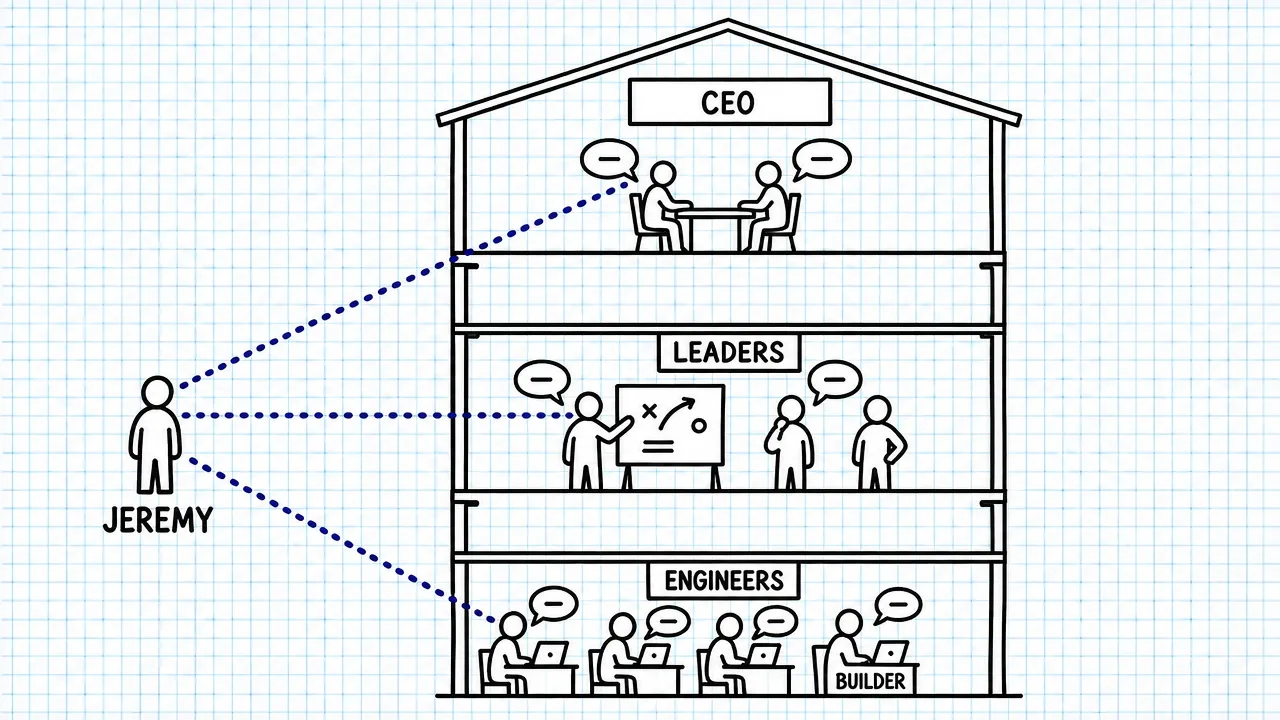
We sit with you, your leaders and your engineers, find where work gets lost on its way from the plan to your customers, and fix it with them. When the first change is live, you take your board a readout, built with your CTO from your own systems, on whether AI is paying off.
The usual answers
Do you slow down? Speed up? Add another agent, or ten?
None of those fixes it on its own, because the gains from AI leak out at the handoffs, where work passes from one person or team to the next. AI puts four of them under new strain. Faros, which sells engineering analytics, studied 22,000 developers at companies deepening their use of AI, and in September 2026 it reported that far more changes were moving through and monthly incidents were up 125%. Here are four questions worth asking, and what we’d do about each.
Source: Faros, September 2026
Does the plan you agreed on still mean the same thing by the time it reaches your engineers?
If the plan changes on the way down, AI gets the wrong thing built faster. We tie the work to your top goals with your leaders, so you can see where engineering’s time goes.
How much of your engineers’ work is waiting on a decision right now?
When building speeds up and decisions take just as long, waiting becomes a bigger share of the time from idea to customer. We work out with your leaders who makes which calls, so less work waits.
Is code getting written faster than your team can review and trust it?
In LeadDev’s 2026 survey, over half said code review and validation is now the biggest bottleneck in delivery. With your CTO, we put the closest checks where a mistake would cost the most, so fewer mistakes reach your customers and finished work reaches them sooner.
Source: LeadDev, 2026
Is what your best engineer knows about AI reaching the rest of the team?
When one engineer figures something out with AI, we make it part of how the whole team’s agents work, so the lesson spreads and a mistake one person caught doesn’t repeat across the team.
What we do
Those are the Four Handoffs.
We look at how your engineers’ work moves from the plan to your customers, and take on each handoff with your leaders and engineers, so more of the gains from AI reach the business.
What we set up
Agents take on more of the work, and a person still decides what reaches your customers.
We set agents up inside your engineering team with four safeguards around them.
- Your business-critical code is covered by tests before any agent works on it. Your CTO names that code, and your engineers keep working on it by hand until the tests lock in what it does today.
- Reviewers can check an agent’s work against what was agreed. Changes above a size your team agrees start from a short spec that says what the change is for and how it will be checked.
- A change that’s missing its spec gets flagged as soon as it’s proposed. We add a check to your code reviews, adapted to the spec tool your team already uses, that looks at every proposed change, and your CTO decides when a flag can stop one from going in.
- We keep agents away from production and from your passwords and keys. Anything that can’t be undone, like a data migration or a message to customers, waits for a person to approve it first.
What we measure
Three answers your board will ask for, in the order that matters.
We take a baseline from the history already in your code, ticket and incident systems, so the numbers hold up when an investor’s technical partner checks them.
Are we building what the business needs?
Progress on your two or three goals, how much of what engineering commits to gets delivered, and how much engineering time goes to new capabilities.
Is delivery faster without getting riskier?
Time from idea to customer, how long work waits on review, and how often a change fails in production or needs an unplanned fix.
Is the AI spend paying back?
What you spend on AI set against those results, team by team.
Who leads it
Jeremy Brooks has sat where you sit, and where your tech leader sits.
He has spent twenty-five years putting data, then machine learning, and now AI to work in real businesses. He has started multiple companies and sold two, and led engineering beside the CEO at two more that were acquired.
Our team is Jeremy, senior builders like Patrick Hrabos who join when the work needs them and work inside your engineering process, and the AI agents we work alongside. Your tech leader stays in charge and makes the calls for their team, and your people carry the change, so it lasts and belongs to them.
“Jeremy is someone you want by your side when you’re challenging the status quo, in growth mode, and looking for a problem-solving running partner.”
Crista Bailey, Jeremy’s CEO at Hideaway Report
The offer
Three steps, measured in your own numbers from the start.
First we listen, to you, your leaders, your engineers and a couple of customers.

- Find what pays You know where the gains from AI are leaking and where you are starting from. Work starts on the handoff costing you the most, then on the others, and the first signals show up in your own numbers.You come away with measures your CTO has agreed, each with a baseline from your own systems.
- Build it in The numbers show how far things have moved at each handoff, and when the first change is live, you take your board a readout against where you started.You come away with that readout, built with your CTO, and the practices your team now runs at each handoff we worked through.
- Keep it runningIf you choose After the readout, you decide whether we keep going.Everything we created stays in your systems, and your team already runs it.
Running partner
For CEOs of growing software companies whose AI plans aren’t turning into results yet.
Before we start, we agree with your CTO the date the first change goes live. If we miss it, we keep building at no charge, as long as we’ve agreed the scope and have access to your systems in time.
A fixed price, agreed before we start.
Stories
What changed at companies Jeremy worked with

100X
increase in the visitor to paid-subscriber conversion rate.
Hideaway Report
As VP of Technology working beside CEO Crista Bailey, Jeremy also led digital marketing and marketing analytics and co-owned the web strategy. Under his lead, the Hideaway Report team built a modern data stack and used machine learning to score which visitors were most likely to join, which paved the way for that increase. It’s why Travel Leaders Group acquired the company in 2020.

Acquired
by Flight Centre Travel Group, the parent of FCM, in December 2021.
Shep
Jeremy joined Shep as head of engineering just before the pandemic shut down corporate travel, and he architected the machine learning that let its browser extension read travel sites without hand-built rules for each one. Together with founders Daniel Senyard and Rey Garcia and the Shep engineers, he turned it into safety guidance for travelers, and the data architecture he designed passed the security audits large enterprises run, so Shep won them as clients. He stayed on, later as an advisor, until the acquisition.

$0 → $1M
a year in recurring revenue for AgileBid.
Ideagility
Jeremy and Mike Ulwelling co-founded Ideagility in 2010 to sell AgileBid, software that took over the hand-tuning of pay-per-click bids for businesses like ServiceMaster Clean, Merry Maids and the Portland Trail Blazers. As CTO, Jeremy led product and engineering while the team turned AgileBid into software a business could sign up for and run itself.
If you’re feeling this, we want to talk to you.
It’s a free thirty-minute call where you walk us through the problem and we ask a lot of questions, and you leave with our honest read on where it lives, whether or not we end up working together. If it’s a fit, finding what pays is the next step, and if we’re not the right people, we’ll tell you who we’d call instead.
Before we talk, ask three people at three levels what this quarter’s most important goal is. If the answers don’t match, that’s where we’d start.
Rather write first? [email protected] or LinkedIn